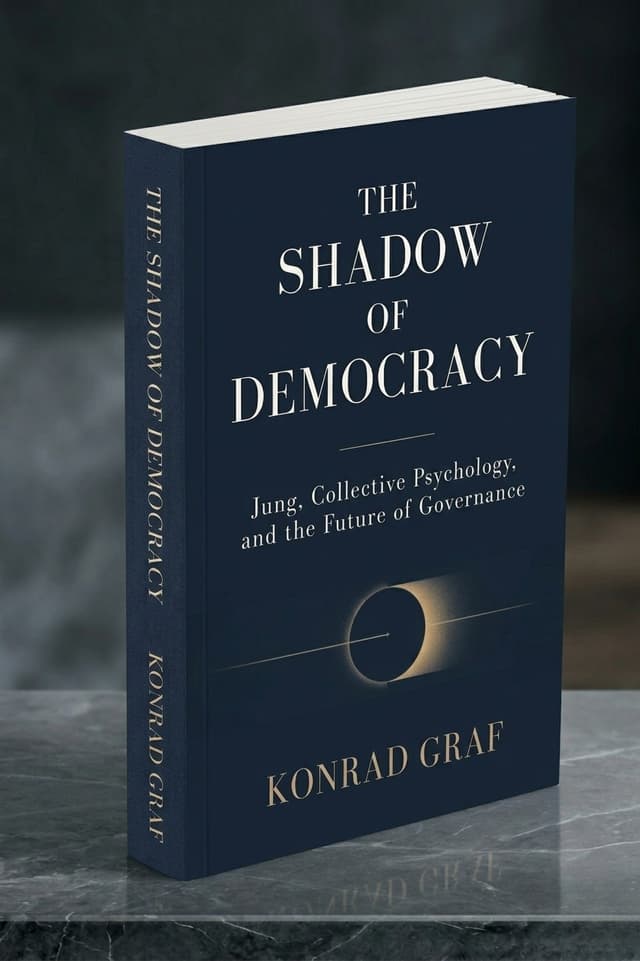
The Shadow of Democracy
Jung, Collective Psychology, and the Future of Governance
Democracy is not only a system of laws and institutions—it is a psychological arrangement, built and maintained by the collective mind of the people who live inside it. The Shadow of Democracy turns to Carl Jung's work on the unconscious to ask a question most political analysis avoids: what happens to a society when it refuses to face its own shadow?
Drawing on collective psychology, Konrad Graf traces how projection, polarization, and unexamined group narratives quietly erode self-governance from within—long before any law is broken or election is contested. The forces that destabilize democracies are often not external enemies, but disowned parts of the collective psyche finding their way back into public life.
This is not a partisan book. It is an invitation to look underneath the noise of modern politics and ask what a more conscious, psychologically mature form of governance could look like—for individuals, institutions, and nations alike.
This book is for you if...
- You want to understand democracy as a psychological, not just political, structure
- You're curious about Jung's ideas on the shadow, projection, and the collective unconscious
- You want to make sense of polarization without picking another side to blame
- You're interested in what a more self-aware form of governance could look like
- You want political commentary grounded in psychology rather than ideology